
Shape memory, when applied to materials, refers to their ability to return to an initial state after deformation. This property involves a form of material intelligence: something acts, moves, imprints itself within the matter, and then restores itself. To this technical dimension is articulated a more diffuse memory, linked to the trace: that of the gesture, the impact, and the aftereffect. Much like a mattress or a cushion, which record a body before releasing it, form results from a tension between the individual imprint (its presence in the negative) and this capacity to reenact what has passed through it. The exhibition Memoria di forma unfolds this poetics of the "before" and "after." This dynamic of tension and release, akin to a spring where form remains in a state of potentiality and stands ready to reconfigure itself, runs through the practices and works of Sila Candansayar, Clédia Fourniau, and Nefeli Papadimouli. This shape memory is embedded in the very structure of Sila Candansayar’s sculpture. Her forms, stretched and articulated, seem to hold like bodies in latency, in equilibrium, in tension, on the verge of a tipping point. Polished wood and blown glass retain the trace of the gestures that shaped them: sanding, carrying, adjusting, and balancing. The sculpture does not represent a body; it reenacts its constraints (weight, gravity, resistance) to the point of manifesting a presence. These anthropomorphic forms, without face or narrative, appear as suspended postures, as possible bodies rather than incarnate ones. They evoke a transitory state, as if the form could at any moment readjust itself, shift its center, or find a new balance.
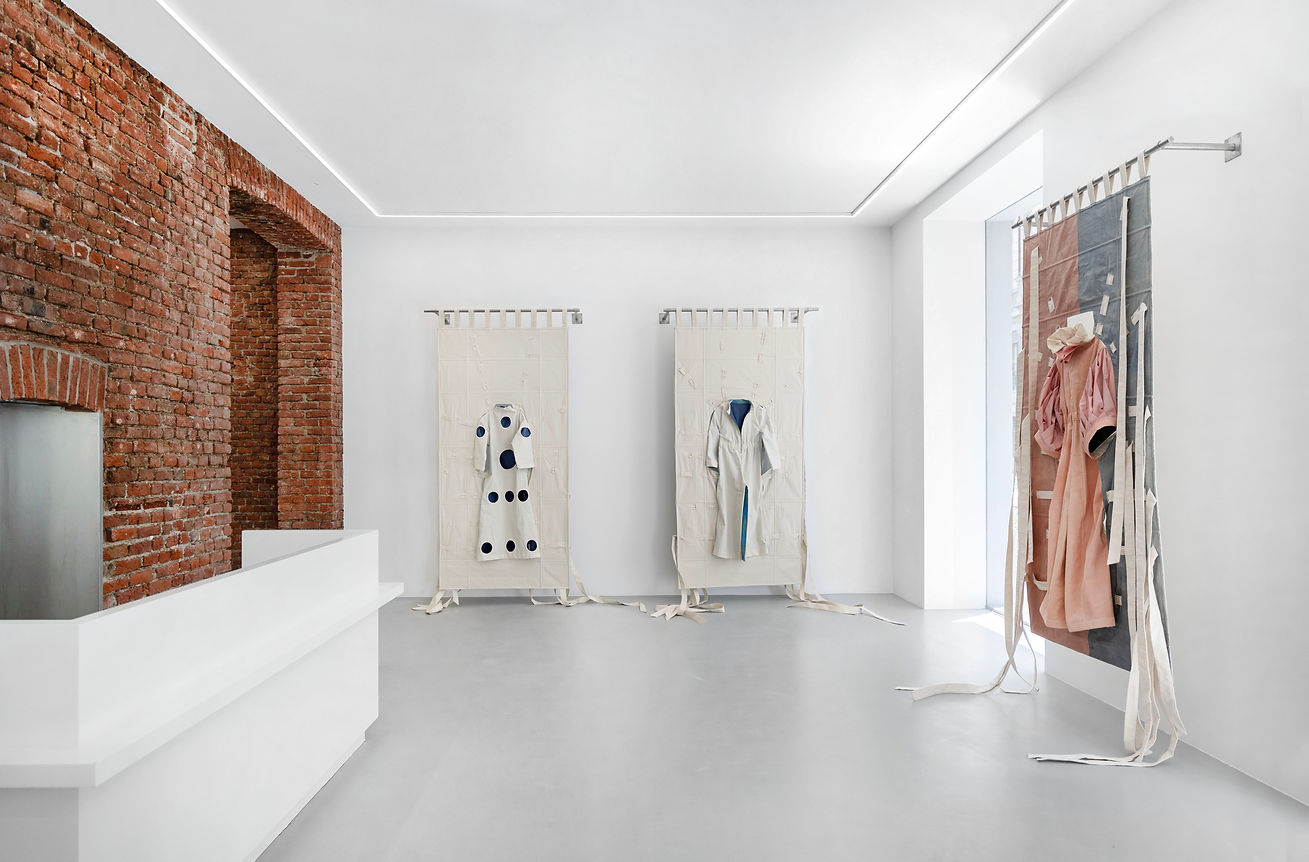
For Clédia Fourniau, this notion shifts toward gesture and matter. Her recent works strip away "color-matter" in favor of a frontal "gesture-form": the canvas is no longer a screen reflecting the body of another, but a space of inscription where the artist’s body emerges in relief. Each line measures a physical amplitude, negotiating between automatism and construction within the duration of making and thinking. The image deploys a lexicon of elementary signs, such as scribbles and rainbows, to perform a deconstruction: the artist reactivates a "shape memory" composed of graphic archetypes and free gestures. These lines, which bypass acquired knowledge to relearn a primal spontaneity, maintain the image in a zone of continuous emergence. As for the works of Nefeli Papadimouli, shape memory is embodied in textile envelopes, or "skin-costumes," that preserve the imprint of the body. Whether suspended or activated, these forms appear as available matrices, ready to be inhabited, moved, or reenacted. Each passage from one body to another actualizes this memory and displaces it. It is no longer merely an individual memory, but an expanded, collective bodily memory where form circulates, is transmitted, and is transformed. While each artist explores a distinct layer of this memory, from structure to gesture and from the individual to the communal, the exhibition ultimately "becomes body." The concept of Memoria di forma then shifts scale to invest the architecture itself: at the Romero Paprocki gallery, the raw brick walls serve as a revealing counterpoint to the plasticity of the works. The work of Sila Candansayar, Clédia Fourniau, and Nefeli Papadimouli unfolds according to a logic of proxemics, where the distance and proximity between two works generate a form in itself. The entire exhibition is thus experienced as a global shape memory: each work becomes imbued with its surroundings, retaining within itself the echo of this encounter, even once returned to its solitude.
Anne-Laure Peressin

© Photo : Allison Borgo

© Photo : Allison Borgo

© Photo : Allison Borgo

© Photo : Allison Borgo

© Photo : Allison Borgo

© Photo : Allison Borgo
© Photo : Allison Borgo

© Photo : Allison Borgo

© Photo : Allison Borgo

© Photo : Allison Borgo